Get a complete overview of Dayate Engineering's capabilities, services, product range, certifications, and project portfolio — all in one detailed document.
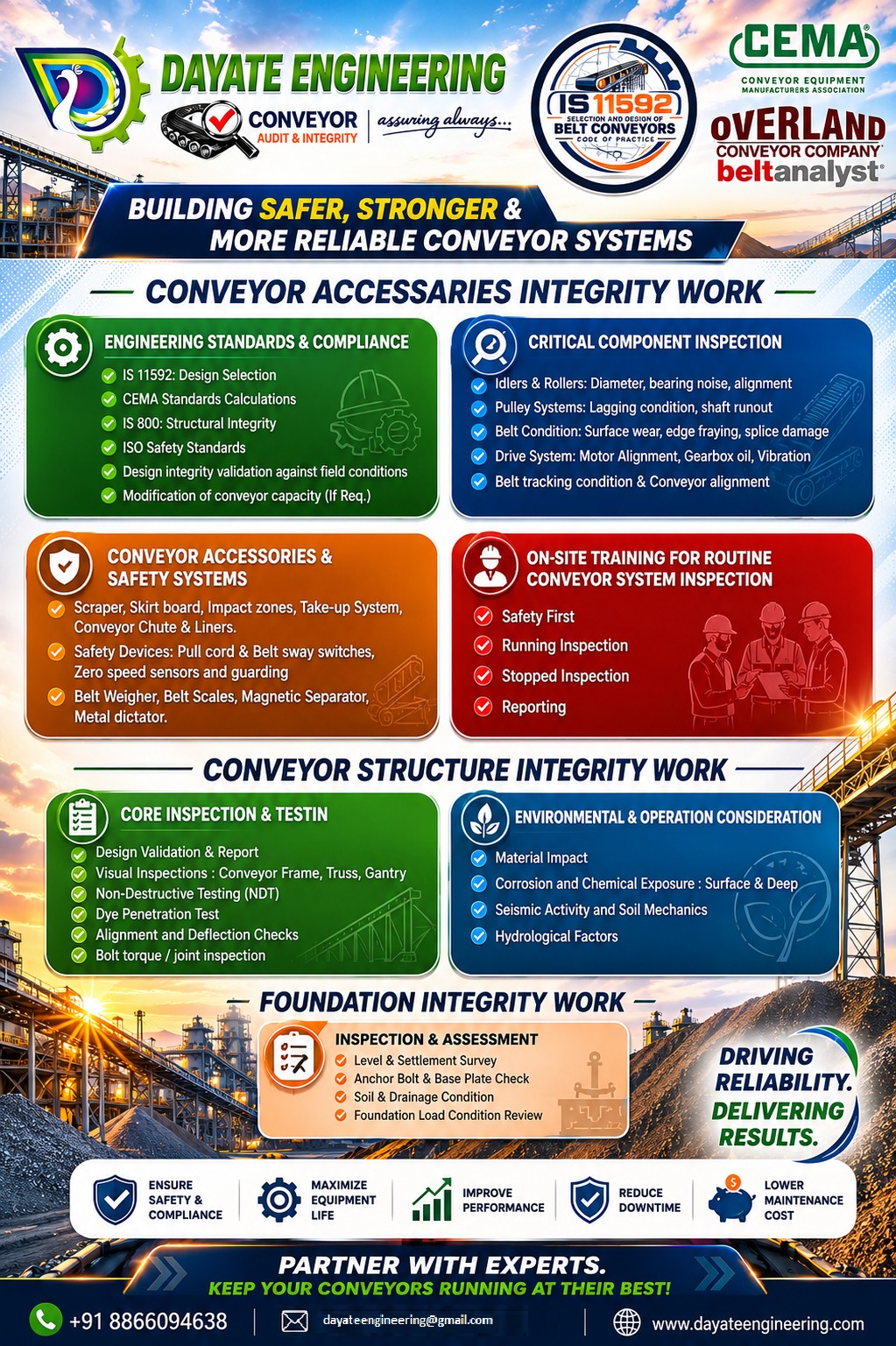
Dayate Engineering's Conveyor Accessory Integrity Framework delivers end-to-end assurance across engineering standards, physical inspection, safety hardware and field training.
Every conveyor system we engineer or audit is validated against established national and international standards. This ensures structural safety, operational efficiency and long-term reliability.
Systematic multi-point inspection covering every critical mechanical and structural element of your conveyor system — conducted by experienced field engineers.
Supply, installation and commissioning of conveyor accessories, safety devices and monitoring equipment — ensuring every machine operates safely and efficiently.
Structured field training for your maintenance and operations teams — equipping site personnel with the knowledge to conduct routine conveyor inspections confidently and safely.
Hazard identification, lockout/tagout procedure, PPE requirements and permit-to-work protocols before any inspection begins.
Inspection of conveyor systems under live operating conditions — belt tracking, idler noise, drive temperatures and material flow.
Detailed physical checks with conveyor isolated — belt condition, splice assessment, structural welds, pulley lagging and safety device testing.
Structured documentation of findings, defect severity classification, corrective action priorities and maintenance scheduling recommendations.
Comprehensive structural inspection, testing and environmental assessment to ensure the long-term integrity and safe operation of your conveyor support structures and foundations.
Rigorous structural validation combining visual inspection, non-destructive testing and precision measurement — ensuring your conveyor frames, trusses and gantries meet engineering standards.
Assessing site-specific environmental and operational factors that directly affect the long-term structural integrity and performance of conveyor systems in industrial settings.
Evaluation of dynamic loading from bulk material — impact force at transfer points, material density variation and surge loading on structural members and chute interfaces.
Assessment of corrosion at surface and deep structural levels — including chemical exposure from process materials, wash-down fluids and atmospheric conditions specific to the operating environment.
Seismic zone classification and soil bearing capacity assessment — ensuring foundations and structural supports can withstand site-specific ground movement and loading conditions.
Review of water ingress, drainage conditions and flood risk — identifying waterlogging risks around foundations and evaluating their impact on structural stability and long-term performance.
Thorough inspection and assessment of conveyor foundations — from anchor bolt integrity and base plate condition to soil drainage and foundation load review — ensuring the stability of the entire conveyor structure.
Precision levelling survey of foundation pads and base plates — identifying differential settlement, tilt and out-of-level conditions that compromise structural alignment.
Inspection of anchor bolt condition, grout integrity and base plate seating — checking for corrosion, loosening, cracking and inadequate bearing area at each support column.
Assessment of soil condition beneath foundation pads — evaluating erosion, water saturation, subgrade stability and drainage adequacy around conveyor support structures.
Review of actual foundation loading against original design intent — identifying overloading conditions resulting from capacity upgrades, additional equipment or structural modifications.
Talk to our engineering team. We'll assess your requirements and recommend the right framework.